The next phase of the Israeli-American plan for Iran has been revealed. With multiple Trump administration mentions of ‘boots on the ground’, we now see a plan forming for the initiation of sectarian and separatist uprisings to further create turmoil in Iran. Per CNN and others:

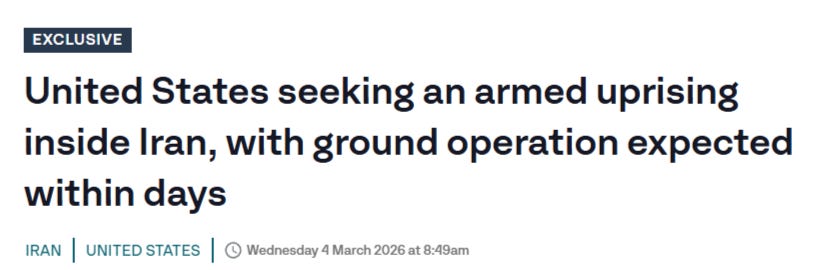
The CIA is working to arm Kurdish forces with the aim of fomenting a popular uprising in Iran, multiple people familiar with the plan told CNN.
The Trump administration has been in active discussions with Iranian opposition groups and Kurdish leaders in Iraq about providing them with military support, the sources said.
Iranian Kurdish opposition forces are expected to take part in a ground operation in Western Iran, in the coming days, the senior Iranian Kurdish official told CNN.
“We believe we have a big chance now,” the source said, explaining the timing of the operation. The source added the militias expects US and Israeli support.
It is said that Kurdish groups in western Iran have been secretly armed and supplied since last year precisely for this moment:
ITV News understands that since last year, weapons have been smuggled into Western Iran to arm thousands of Kurdish volunteers. They are expected to begin a ground operation within days.
This is what the ‘boots on the ground’ possibilities likely refer to—there’s no chance of an Iraq war or Desert Storm-level mass invasion, but there could be units of American special forces embedded with these Kurd guerillas to “lead them from behind” in inciting as much havoc as possible.
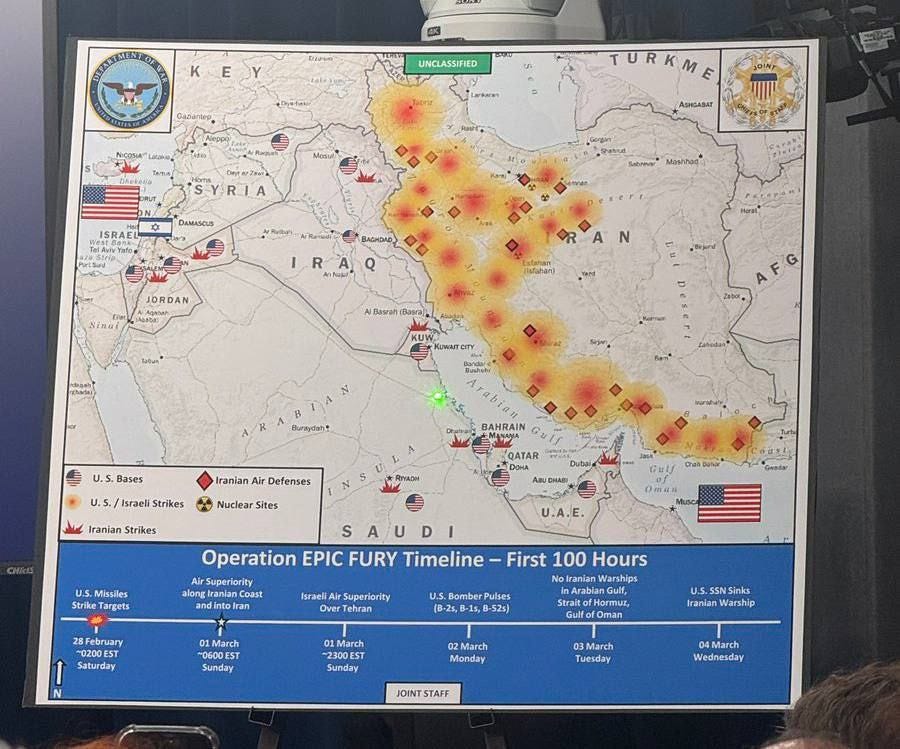
It’s said the bombing campaign targeting western Iran was done specifically to degrade defenses there and open a kind of gateway for these guerillas to move in. The ultimate plan is of course not for such Kurdish units to march all the way to Tehran like some kind of Napoleonic grand army, but rather to demoralize and destabilize the state as much as possible in order to effect a mass popular uprising against “the regime”. This entire war is as much a psychological operation as a kinetic one.
Interestingly, this was followed by reports from Iraq that “mysterious troops” were inserted via helicopter drop to the Najaf desert area of south-central Iraq:

Al-Fatlawi said in a statement seen by independent Arabia, that "a force believed to be American carried out a rapid landing operation in the Najaf - Karbala desert in southwestern Iraq, at six o'clock on Tuesday evening, according to what was reported to us, the force entered from Syria, with a number of four to seven helicopters, accompanied by The deployment of Hummer-type military vehicles in an area about 40 kilometers from Al-nukhayb,"he said.
An Iraqi MP claims Iraqi military went to investigate the site of the landing, only to get “shelled” by someone, resulting in one of their soldier’s deaths. Well, it’s not surprising that US special forces would be trying to stir something up.
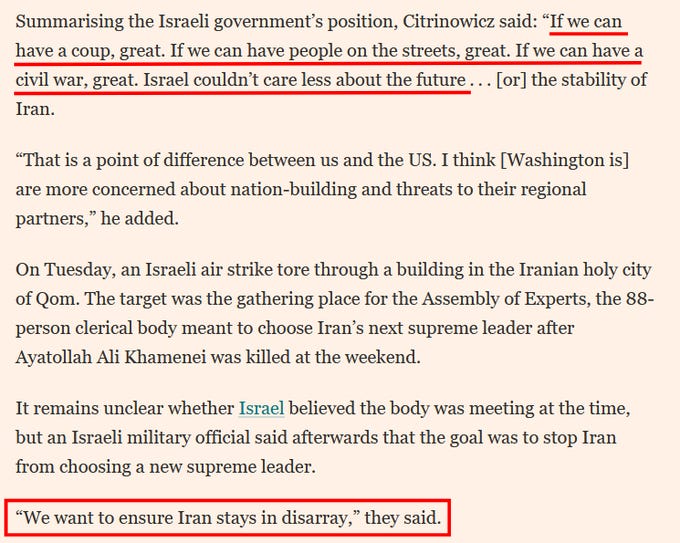
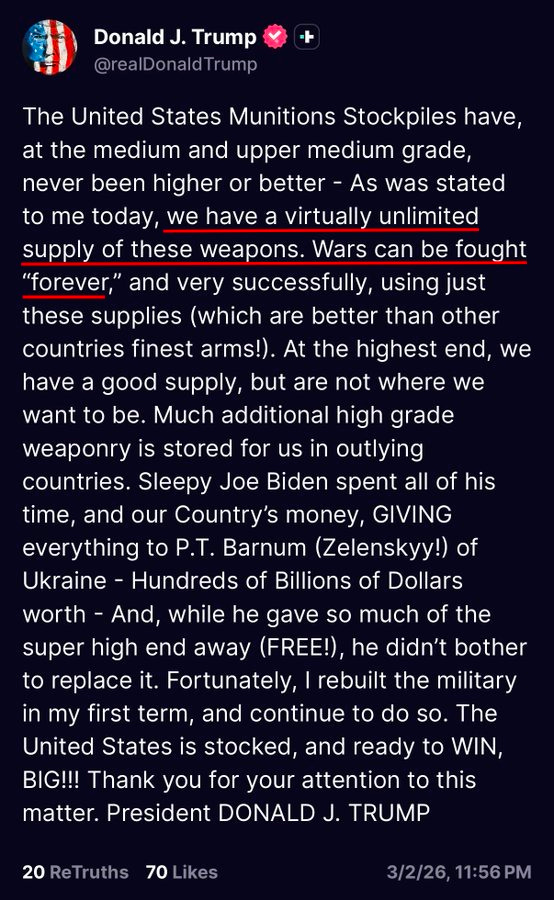
Now the debate has turned to who was actually prepared to out last who. Hegseth and other supporters of the Trump admin have now claimed that the US has a virtually “limitless” supply of medium-level precision weaponry, which essentially refers to JDAMs and SDBs. Trump himself blurted this out yesterday as he panickedly sought to calm fears about US munition reserves. Rather than calm nerves, he managed to put people even more on edge by implying he’s open to exactly the type of ‘forever-war’ he campaigned against:
US JDAMs are based on Cold War-era MK-84 “old iron” bombs which are plentiful and can allegedly be manufactured to the tune of tens of thousands per year, not unlike Russia’s Fab bombs with UMPK glide kits.
SDB production capacity: 10,000/year
JDAM kit production capacity: 25,000/year
So in one sense, Trump here is right, although he could be underselling the true criticality of US’s magazine depth for higher level prestige systems like THAADs, Patriots, Tomahawks, etc. But in general, it’s true the US can deliver JDAM strikes virtually indefinitely, and many believe Iran’s air defenses have now been attrited enough to allow the US to carpet bomb Tehran with total impunity, which both Israel and the US appear to be doing as of today.
Earlier scenes from Tehran:
That said, there is not yet any indication Tehran is being hit with such munitions, rather than ballistics like Air LORA, Blue Sparrow, various cruise missiles like Tomahawks, etc. There was one video showing an Israeli F-35 or F-15 firing off flares that was reportedly taken somewhere near Tehran, though some sources said it was “in the mountains north of Tehran”. If that’s true—and it likely is for logical reasons—that means the attacks on Tehran are as usual taking place from the north Caspian Sea route, presumably with Azerbaijan’s aid. This would mean Israeli planes are not overflying Iran proper, which further suggests that Iran’s air defenses are not attrited as much as claimed.
The footage which US and Israel have released so far of strikes on Iranian launchers and other assets leaves much to be desired. A huge portion of it appears to show strikes on various decoys, fake painted murals of planes, and disposable objects like single Shahed drones, which themselves appear decoys set in place to attract strikes.
As with the last 12 Day War, we are now hearing the same narrative: that Iran’s strikes have dropped off exponentially each day.
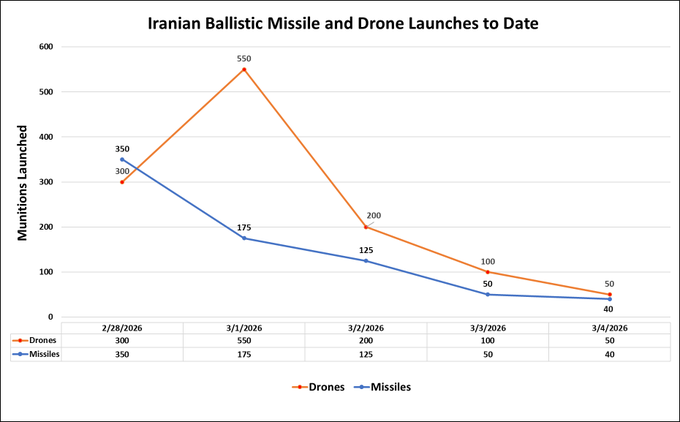
CENTCOM claims Iranian missiles strikes have already dropped by 86% since the mass opening salvo. This is the exact same narrative as before—and recall that even with this drop-off rate, Iran still managed to force Israel to cry uncle and seek a quick off-ramp:
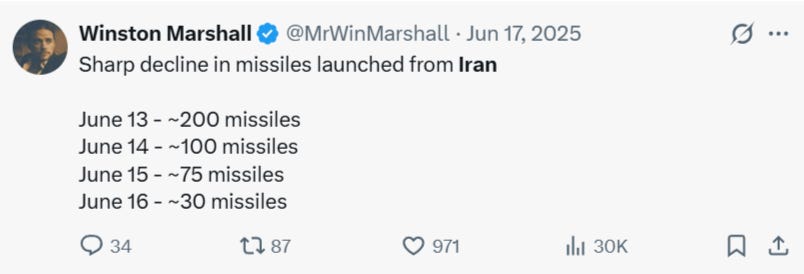
Iran’s previous explanation in the last war was simple: The Israeli air defenses had been attrited to such a degree that Iran could fire fewer and fewer missiles for the same exact efficacy because it no longer needed mass ‘saturation’ to bypass the defenses.
Now we know for a fact that Iran has vastly attrited American air defense capabilities in the entire region, verifiably hitting everything from THAAD radars and major AN/TPY-2 systems, as confirmed by NYT’s satellite research.
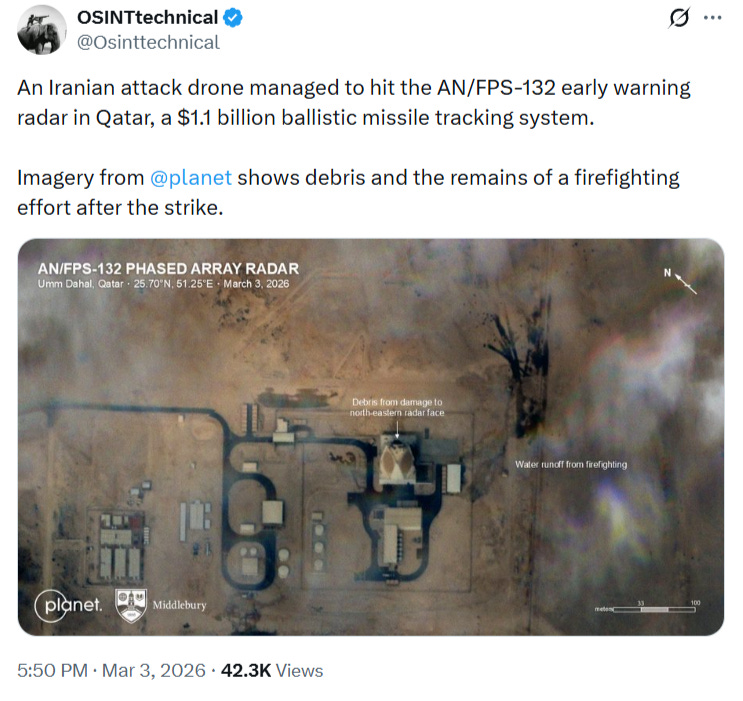
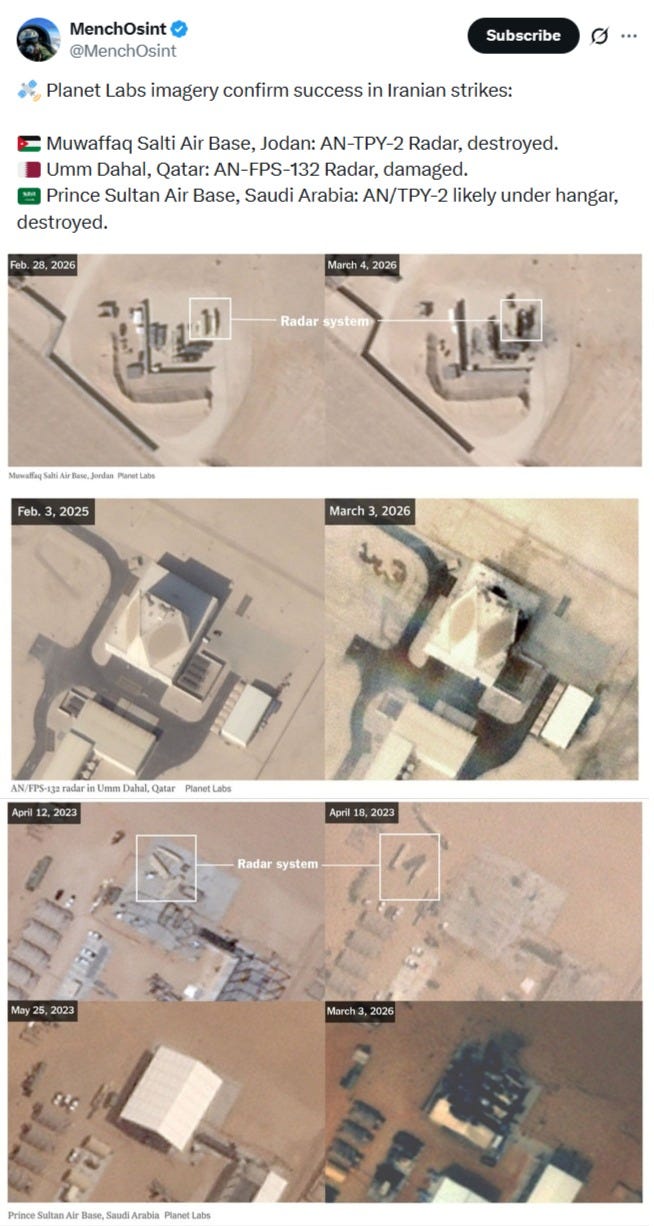
Can we say for certain that Iran’s output drop is related to this? No—nothing in the ‘fog of war’ propaganda-laced information field can be known for certain. But what we can do is go by precedent, which tells us that after months of similar-intensity bombing, the entire NATO coalition was not able to even appreciably attrit the air defense network of Serbia, a country a tiny fraction the size and population of Iran.
Iranian General, Sardar Bahman Kargar: “At the same time as missile launches, we are also producing missiles and have no concerns about military equipment reserves.”
In the US there are some “signals” about munition issues. For instance, top MIC execs are heading to the White House to discuss supplies while Trump has now announced a $50 billion dollar supplemental budget request to presumably restore what’s already been used:
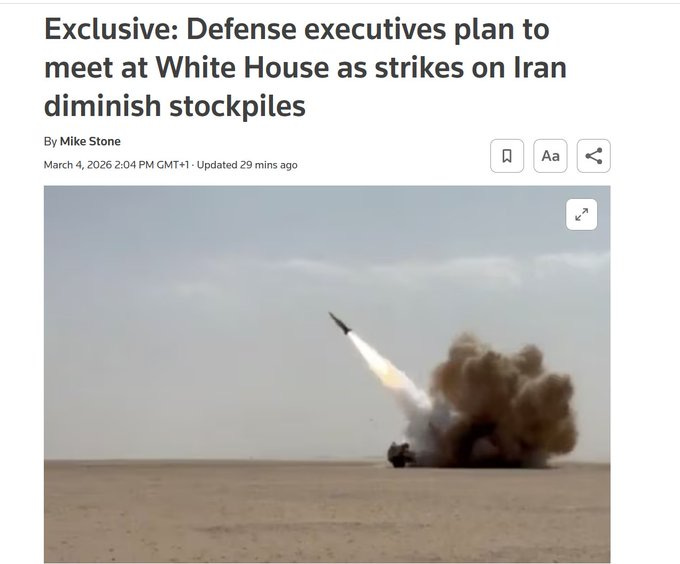
Directly from Reuters above:
The White House meeting comes as Deputy Defense Secretary Steve Feinberg has been leading Pentagon work in recent days on a supplemental budget request of around $50 billion that could be released as soon as Friday, one of the people said. The new money would pay for replacing the weapons used in recent conflicts including those in the Middle East. The figure is preliminary and could change.
Some sources are claiming the war is running the US about $1B per day thus far, while Israel is paying the piper to this tune:
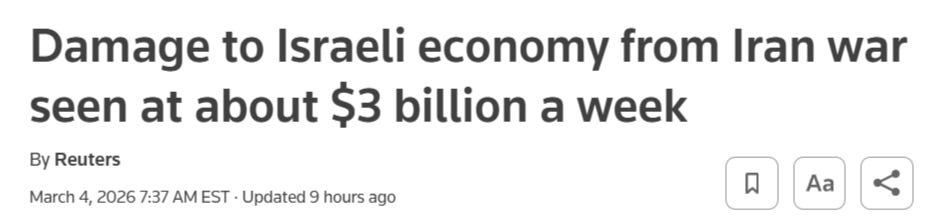
For comparison, Russia’s SMO—in dollar terms—is said to cost about $370 million per day, according to Russia, and $500-600 million according to Western sources.
In the interests of answering the question of where does the war currently stand, and who has the upper hand, we must understand that pro-American commentators have an incorrect conception of what “winning” looks like. No one said Iran would ever be able to openly defeat the US in a purely military exchange: just like Vietnam, it’s about surviving and taking the aggressor into the “deep end”, which is not solely about material attrition, but moral and socio-political attrition as well.
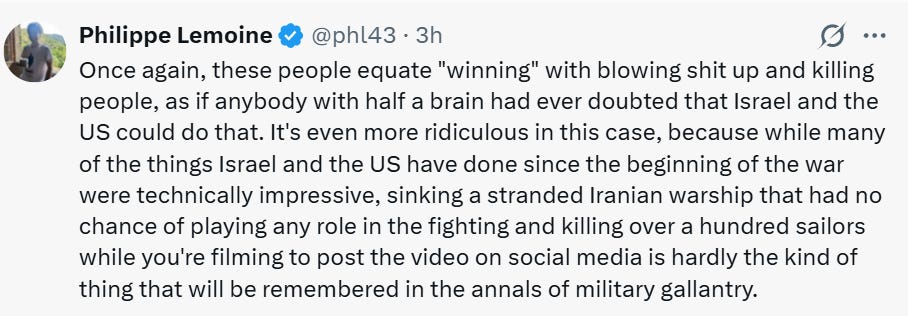
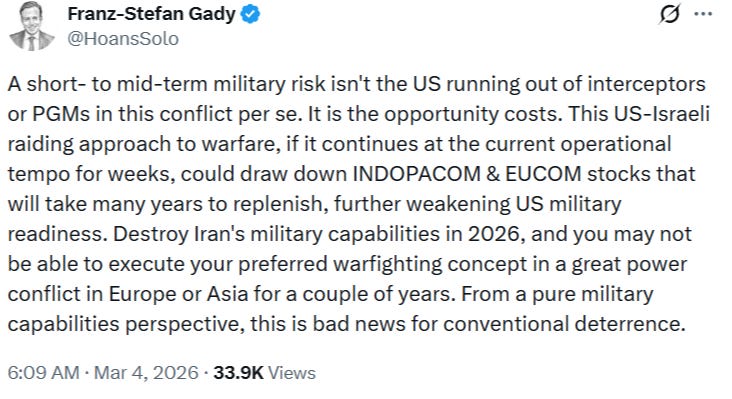
The US’s brag about maintaining ample supplies of lower level munitions like JDAMs may mean something insofar as the Iranian war, but it sets the US back by years and perhaps even decades against other actual near-peer powers like Russia and China as the US will never be able to fully replenish its stocks of major prestige systems which the US has simply lost the ability to build at scale.
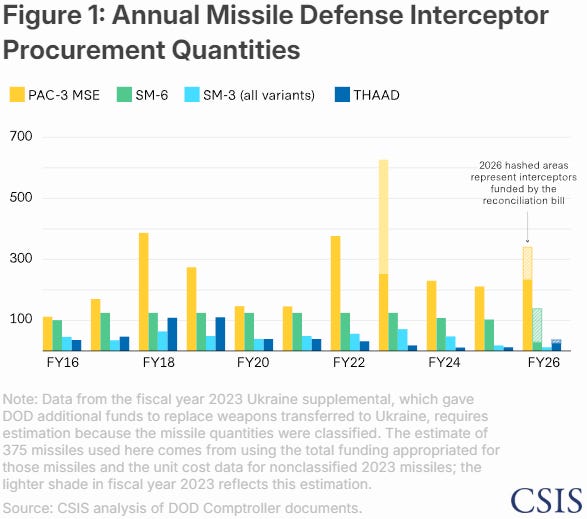
In short: the US is critically weakening itself in a long, drawn-out exchange with Iran which has major second and third-order geopolitical consequences for the US further down the line. Military analyst and historian Franz-Stefan Gady underscores this point:
Another good assessment of the situation from Amerikanets:
Missile attrition war update: I keep seeing people focusing specifically on the number of Iranian MRBMs launched at Israel. This is a relatively unimportant metric to index on for several reasons.
The Iranian strategy in this phase is a response to renewed US/Israeli air attacks. What they need to do right now is hunker down in their underground bases and weather the storm, while firing enough MRBMs to attrit US/Israeli interceptor magazines. Interceptor stocks represent a hard limit on the presence of certain assets in the region, because the carriers can't operate if the DDGs defending them run out of interceptors to protect the carrier.
Hezbollah is helping to pick up the slack in pressure on Israel itself by lobbing short range missiles and drones at Israeli territory. Meanwhile, satellite imagery released over the past 48 hours shows that despite the US/Israeli air campaign, the Iranians are systematically destroying our air defense network across the region. We've lost key radars in Kuwait, the UAE, and Qatar. Yesterday the Iranians fired a single missile at an unknown target in the Negev, which was likely one of our few remaining THAAD radars. We're unlikely to receive any proof of what happened there.
The single most important theater right now is the Gulf, where the Iranian drone campaign is continuing. Qatar announced they're stopping *all* production of natural gas this morning. They're the world's second largest supplier and this could have severe ramifications for the global economy. Tanker traffic is down over 90% in the strait, and the Iranians continue to hit ships that attempt transit. Trump's wild suggestion that the USN might provide escorts through the straight was immediately shot down by the Navy itself.
The Iranians can keep targeting infrastructure throughout the region even at a massively reduced pace compared to Saturday and still impose a historical economic crisis on the Gulf states and their customers worldwide. And as they continue to destroy radars, the value of every MRBM they launch increases. Just a handful of drones getting through to the right places in the Gulf daily is enough to keep oil and gas production offline.
The US victory condition at this point is to *permanently stop* all Iranian drone attacks. Even if we achieve air supremacy over Iran (Hegseth said today we have yet to do this), this may not be possible. It's an open question how long we can keep up the tempo of this air campaign, and if the Iranians keep setting up SAMbushes we'll begin to lose air assets.
The Iranians still aren't going all out against Gulf oil and gas sites. As it stands, if their drone campaign stopped today and the strait reopened, it would take around a month for exports to return to normal. This allows a path to de-escalation. But with a Kurdish ground invasion of Iran looming, the Iranians can choose to take another step up the escalation ladder and start systematically destroying oil production sites instead of just hitting them with pinprick attacks to keep them offline. They can also begin targeting Saudi sites with SRBMs.
A Turkish admiral further elaborates on the logistical strain created by Iran’s fire-control over key American resupply ports:
Retired Turkish Admiral Cem Gurdeniz:
American ships cannot go to Bahrain to resupply ammunition. There isn’t a single US warship in the Gulf right now.
Where will they go to load missiles? To Diego Garcia. How much does it take to go there and back from the Arabian Sea? 7 days...
The US has the capacity to produce serious, expensive missiles between 800 and 1000 per year.
The other side (Iran) has 40,000 missiles and says, “We will not negotiate with the Americans.”
So, they have a strong hand; that’s what I deduce from this.
It’s a game of Chicken, with Trump betting on Iran’s socio-political collapse from the overbearing pressure of the Israeli-US ‘shock and awe’ campaign. The problem is, Iranian people appear to have gained solidarity as result of the barbarism inherent to US and Israel’s strikes, rather than losing morale. Not only has their spiritual leader been killed, but a school was bombed, reportedly killing over 160 young girls which has outraged the nation and produced optics sure to radicalize many against the US.
This was said to be a massive gathering yesterday in support of the leadership:
Suriyak correctly concludes:
After the first five days of the US operation Epic Fury against Iran, there are still no signs of a collapse of the Iranian political regime. In fact, the continuous bombing and hundreds of civilian deaths have caused Iranian social sectors opposed to or critical of the political regime to close ranks around national defence or adopt a passive stance. The prolongation of the conflict will only cause the Iranian political regime to become more entrenched and hardened, leaving little room for internal rebellion.
That is why the United States is preparing a new phase of the war in which it will exploit one of Iran's natural pillars: its cultural diversity.
Of course, as I had already predicted weeks ago, the most likely scenario is still both sides becoming exhausted enough to seek off-ramps while both justifiably claiming victory over the other. Justifiable because, depending on your outlook, both sides will have “won” as per their own objectives. Iran gets the moral victory simply by keeping the US-Israeli axis from achieving its chief objectives; despite taking massive damage, Iran will have achieved a humiliation of the US by simply resisting to the end and keeping itself politically intact. The US-Israel will have achieved major “victory” by destroying Iran’s leadership, large amounts of its military hardware, and setting it back economically a great deal. Supporters of both sides can reasonably cite their preferred criteria as being consistent with their definition of victory.
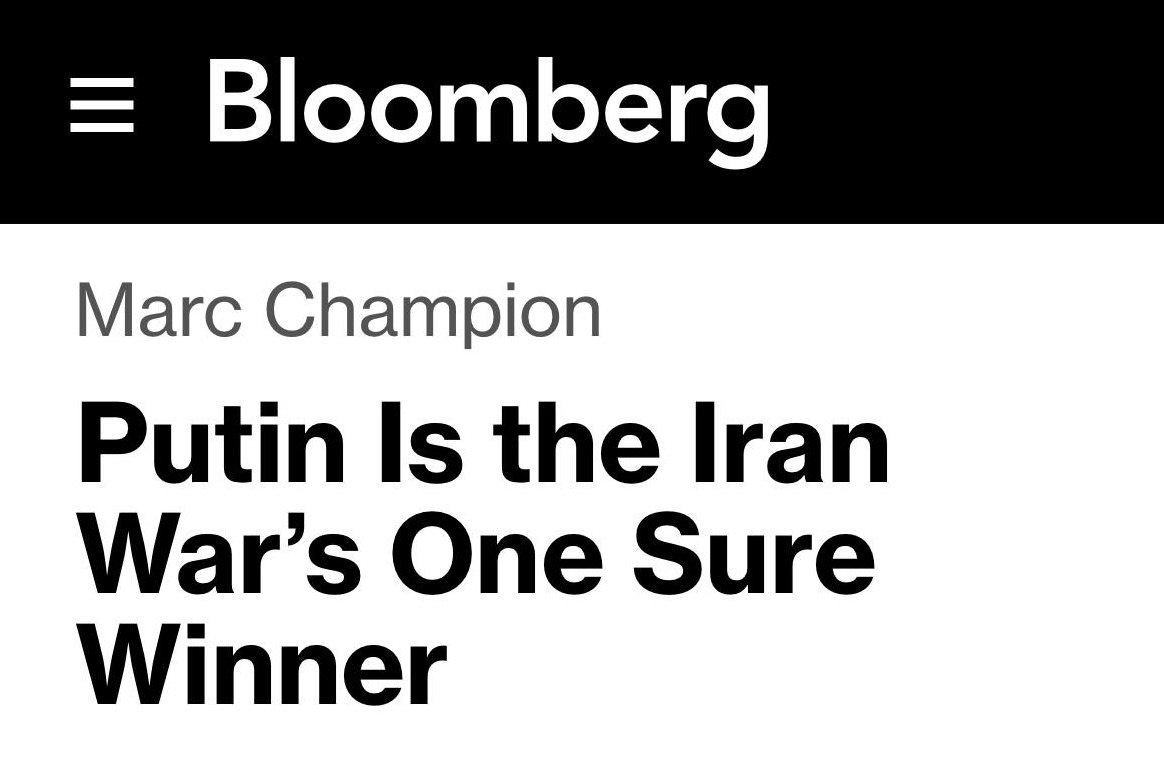
No matter who wins, Bloomberg is convinced it’s Russia that’s the true winner of the conflict, echoing my earlier sentiment about second-order consequences:
Summary:
US naval vessels are firing Tomahawk missiles at Iran to destroy missile launchers and factories, making it less likely for the US to provide Tomahawks to Ukraine.
The conflict with Iran could benefit Russia by draining US missile magazines, driving up global oil prices, and potentially reviving the market for sanctioned Russian energy.
A prolonged war with Iran could deplete US capabilities needed to deter challenges from Moscow and Beijing, and may lead to a ceasefire in Ukraine that favors Russia.
Even ultra-Zionist Blinken believes Trump should simply “declare victory” with the Ayatollah dead and Iran’s nuclear program degraded, and pull out of the war immediately.
We end with another small glimpse into the state of the Iranian nation and society at large:
During a sermon at the Imam Raza Shrine in Mashhad, the elegy reciter routinely says, 'May Allah protect the Leader.' However, upon recalling that Ayatollah Khamenei has already been martyred, both he and the attendees are overcome with grief and begin to weep.
—
5 days into the war, what is your current sentiment on its outcome?
US will win decisively, topple Iran
Long Vietnam-like conflict to ensue
Both exhausted, will off-ramp soon
25 VOTES · 2 DAYS REMAINING
Your support is invaluable. If you enjoyed the read, I would greatly appreciate if you subscribed to a monthly/yearly pledge to support my work, so that I may continue providing you with detailed, incisive reports like this one.
Alternatively, you can tip here: buymeacoffee.com/Simplicius